
Vrinda STEM &
Academic Learning Centre
An Ontario-based supplementary learning platform by Vrinda Global Group Inc. providing innovative, hands-on, and technology-oriented programs designed to complement regular day schooling, develop future-ready skills, and inspire Canadian innovators.
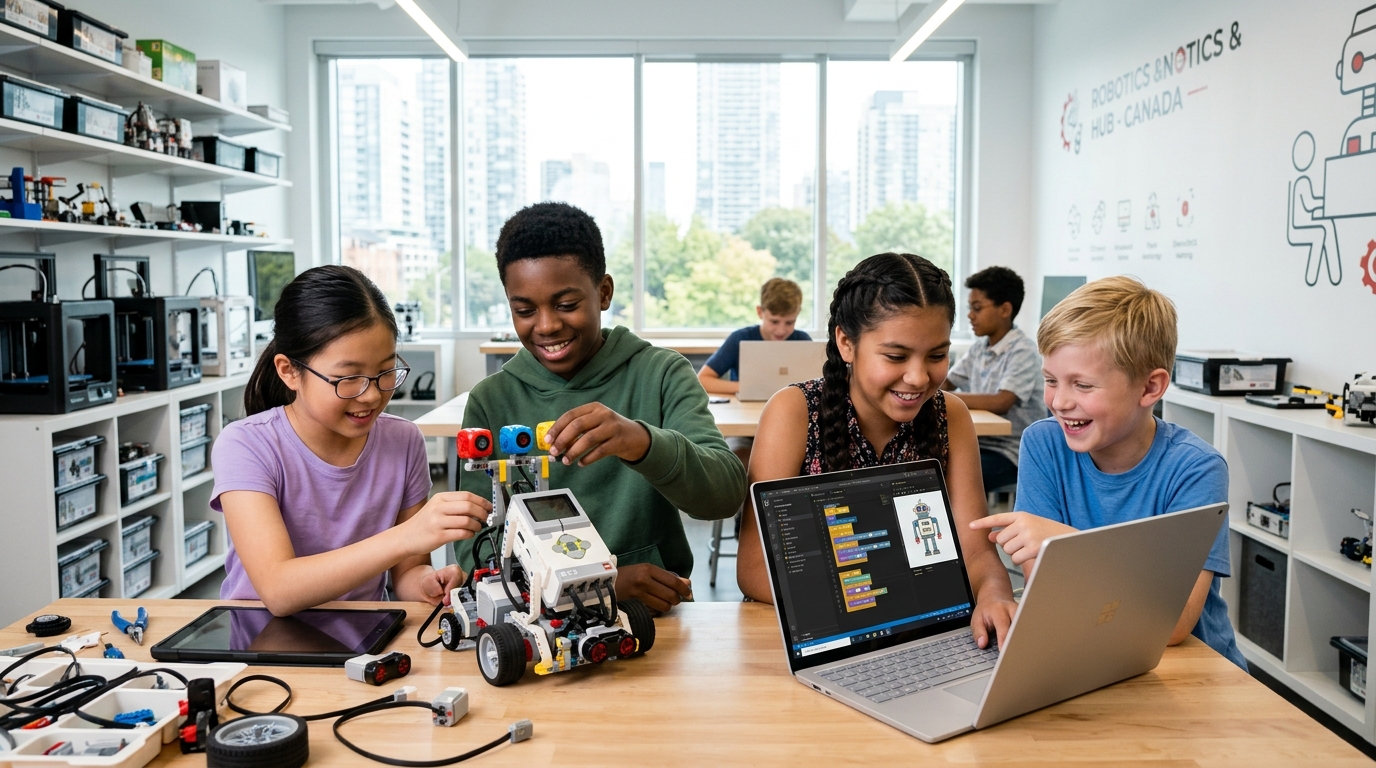
Robotics & Automation
Sensors, Mechanics & Autonomous Rovers
Students build real physical machines from chassis to telemetry code, testing autonomous navigation in our Whitby robotics arena.
Vrinda Global Group Inc.
“Empowering Minds. Building Global Futures.”
Operating with a dual heritage spanning premier international K–12 institutional excellence and Ontario's forward-looking technology mandate. Headquartered in Ontario, Canada, the group delivers high-caliber STEM enrichment, academic support, and teacher professional development.

9 Supplementary Learning Opportunities
Operating outside regular school hours, our enterprise provides hands-on, supplementary learning opportunities across 9 interdisciplinary domains designed for Canadian youth:
STEM Education
Integrated hands-on inquiry across science, technology, engineering, and mathematics, connecting theoretical laws to observable physical phenomena.
Robotics
Designing, building, wiring, and programming intelligent mechanical robots equipped with gearboxes, DC motors, and sensory feedback loops.
Artificial Intelligence
Demystifying how smart algorithms work, exploring neural networks, computer vision, natural language models, and ethical AI stewardship.
Coding & Computational Thinking
Structured computational logic moving progressively from visual block-based Scratch code to production Python syntax, data structures, and algorithms.
Mathematics & Science Enrichment
Accelerating Ontario curriculum comprehension through spatial geometry, algebraic modeling, calculus readiness, and practical physics experimentation.
Project-Based Learning
Every concept culminates in tangible, portfolio-ready builds where students engineer working hardware gadgets, rovers, and software utilities.
Problem-Solving & Innovation
Cultivating analytical resilience by systematically teaching diagnostic debugging, multimeter testing, code profiling, and root-cause analysis.
Weekend & Summer Programs
Flexible, high-intensity technology bootcamps, holiday hackathons, and summer immersion camps designed for busy Canadian family schedules.
Teacher Training & PD
Accredited pedagogical professional development empowering Ontario certified teachers to integrate robotics, coding, and AI into their day classrooms.
Applied STEM & Technology Curricula
Designed to build progressively from foundational physical science into advanced robotics and artificial intelligence:
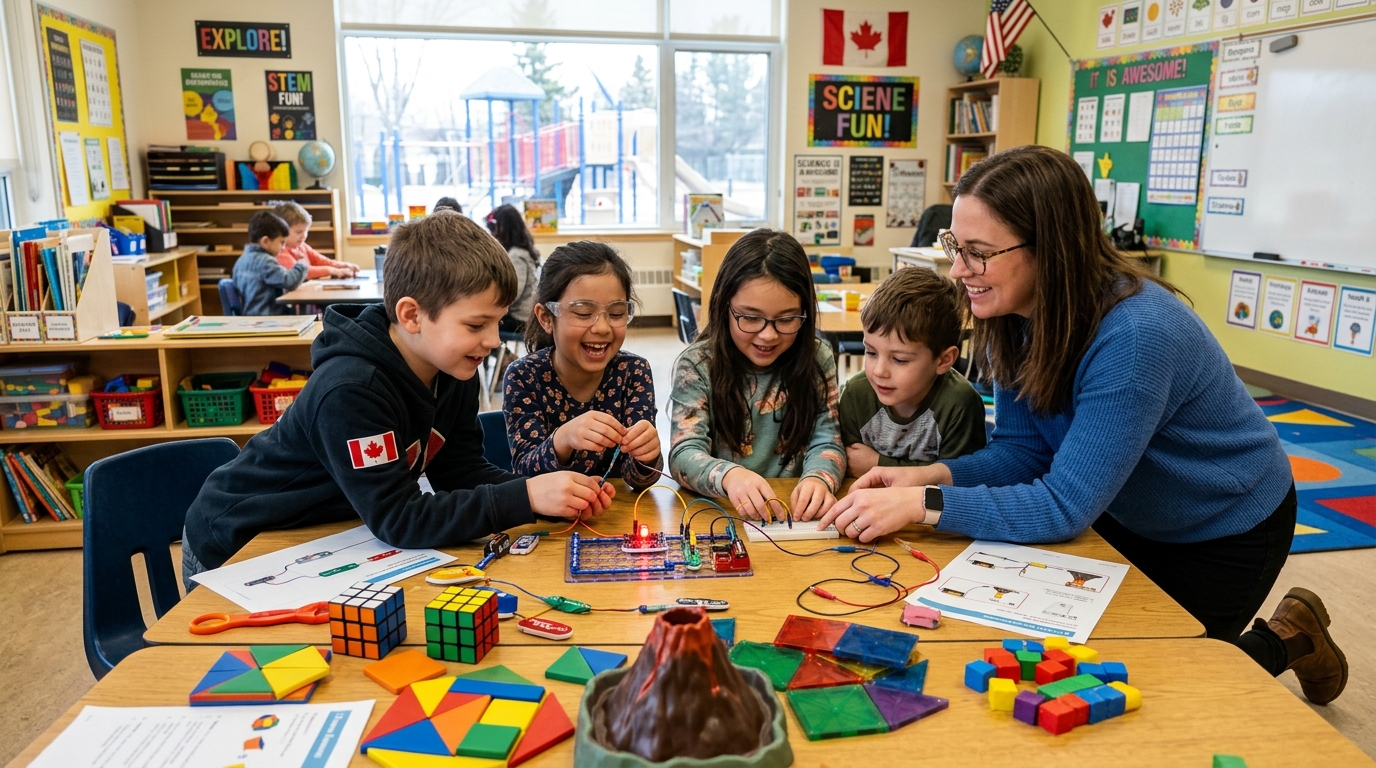
STEM Foundations
Curiosity, Science Experiments & Early Math
Inspiring curiosity and logical reasoning in younger minds through interactive experiments, building manipulatives, and foundational math games.
3-Tier Age Pathways (Ages 6 to 18)
Every student enters at their developmental readiness level and progresses through our structured competency roadmap:
Hands-On Discovery
Sensory engagement using physical manipulatives, gear assemblies, and playful visual programming to foster confidence.
- ✓ Physical science experiments
- ✓ Spatial geometry & numeracy
- ✓ Scratch visual coding logic
Junior Hardware Stack
Designed for safety, rapid prototyping, and tangible immediate feedback that delights young learners.
Autonomous Junior Game & Lever
Learners design their own animated Scratch game and assemble a mechanical crane before advancing to microcontrollers.
The 120-Minute Session Flow
Every weekend or evening supplementary session at our Whitby centre follows a rigorous 5-phase structure ensuring active engagement:
Phase 1: Conceptual Hook
15-minute interactive primer connecting the day's challenge to real-world physics, space missions, or smart algorithms.
Phase 2: Hardware Assembly
Physical wiring, motor calibration, and breadboard connections under the direct guidance of qualified Canadian instructors.
Phase 3: Logic & Code
Writing code in Scratch or Python to control sensors, process inputs, and orchestrate automated motor responses.
Phase 4: Debug & Test
Live arena testing on obstacle tracks, debugging code syntax, analyzing circuit voltage, and refining performance.
Phase 5: Peer Showcase
Learners pitch their functional prototype, explain their logic, and document progress in their innovation portfolio.
Why Vrinda Supplementary STEM?
Operating outside regular school hours, our centre bridges the critical gap between conceptual school curricula and real-world technology execution.
Traditional Classroom Limitations
- ✕Primarily theoretical textbook problem sets with rare physical hardware testing.
- ✕High student-to-teacher ratios (25–30+ students) restricting individualized feedback.
- ✕Limited access to dedicated microcontrollers, robotics arenas, or AI sandboxes.
- ✕Pacing dictated by rigid standardized curriculum schedules rather than mastery.
Applied, Hands-On Technology Mastery
- 100% Tangible Builds: Every student handles physical components, motors, and code.
- Small-Cohort Pods (1:8): Individual attention from qualified Canadian mentors.
- Dedicated Lab Hardware: Arduino, Raspberry Pi, ultrasonic sensors, Python & AI tools.
- Non-Disruptive Synergy: Flexible evening and weekend times to fit busy family schedules.
The 5-Stage Innovation Stepper
Moving beyond traditional classroom learning to apply mathematics, science, and technology to practical projects:
Learn: Core Foundations & Concepts
Pedagogical Focus
Students absorb fundamental scientific laws, mathematical logic, and coding syntax through interactive, inquiry-led instruction.
Lab Activity
Guided conceptual breakdown, real-world examples & interactive vocabulary.
Measurable Outcome
Strong foundational knowledge & clear theoretical understanding.
Find the Perfect Program for Your Student
Select your child's age group and main curiosity to see our tailored curriculum match.
Intermediate Robotics & Automation
Perfect for students who want to build motorized rovers, program ultrasonic and gyro sensors, and participate in friendly engineering challenges.
State-of-the-Art STEM Innovation Labs
Located at 1628 Rossland Rd E in Whitby, Ontario, our campus features 4 dedicated technology environments.
Robotics Arena & Testing Track
Custom obstacle arenas, terrain tracks, and sensor calibration zones for rovers and robotic arms.
Coding & AI Software Studio
High-speed workstations equipped with modern developer environments for Python, Scratch, and web builds.
Physical Prototyping Workshop
Structural engineering tables with breadboards, electronic component drawers, and 3D prototyping tools.
Academic Math Collaborative
Focused small-group seminar tables designed for step-by-step mathematical reasoning and physics inquiry.
Reinforcing Ministry of Education Standards
Our supplementary curriculum is thoughtfully structured to deepen and accelerate the competencies taught in Ontario elementary and secondary schools:
Academic Tutoring
One-on-one and small group support for Ontario school grades 1–12 in math and sciences.
Competition Prep
Coaching for First LEGO League, Canadian Computing Competition, and regional science fairs.
Teacher Professional Development
Accredited pedagogical workshops empowering Ontario certified teachers to integrate robotics & AI in their classrooms.
Leadership & Board of Governance
Steered by three decades of international educational leadership and modern Canadian enterprise direction.
Vijay Luxmi
Founder & MD, Vrinda International School
~3 Decades Experience (Since 1996)An experienced educationist who has progressed from classroom teaching to academic leadership, school administration, and educational entrepreneurship. Leading curriculum planning, teacher training, and institutional management.
Sargundeep Singh
Director, Vrinda Global Group Inc.
Enterprise Strategy & Tech OperationsLeading Canadian enterprise expansion, Whitby facility infrastructure, procurement of advanced robotics and computing hardware, and establishing partnerships with Ontario school boards and community organizations.
Frequently Asked Questions
Does Vrinda Learning Centre replace regular day schooling in Ontario?▼
No. Vrinda Global Group Inc. operates strictly as an innovative supplementary educational learning centre outside regular school hours (evenings, weekends, holidays, and summer breaks), designed to enrich and complement students' regular schooling.
What age groups are eligible to participate?▼
Our initial target market encompasses students approximately 6 to 18 years of age, categorized into Junior STEM (6–10 years), Intermediate STEM & Robotics (10–14 years), and Advanced Coding, AI & Robotics (14–18 years). We also offer professional development for educators.
Who leads the academic and institutional direction?▼
The enterprise is founded by Vijay Luxmi, an educationist with three decades of experience and founder of Vrinda International School (Faridabad, India), alongside Director Sargundeep Singh leading Canadian enterprise strategy, infrastructure, and community partnerships.
Do students need prior coding or robotics experience?▼
No prior experience is necessary. Our tiered curricula begin with foundational hands-on exploration and progress systematically to advanced object-oriented code, microcontrollers, and neural network concepts.
Where is the centre physically located?▼
Our facility is located at 1628 Rossland Rd E, Whitby L1N 9Y3, Ontario, Canada, with modern laboratory pods and robotics testing setups.
Give Your Child the Future-Ready Advantage
Visit 1628 Rossland Rd E, Whitby L1N 9Y3 for a complimentary, no-obligation discovery assessment.